Find the holes before attackers do.
I test your website, web app, API or network the way a real attacker would, with your written permission. Then you get a clear report of what I found, how serious it is and exactly how to fix it.
// Manual testing, not just an automated scan · OWASP methodology · Kampala-based
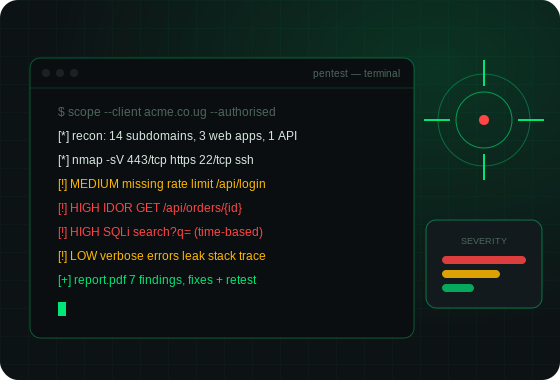
Pick what matters to your business
Most small businesses start with their website or app. Bigger organisations add their network and cloud setup.
Web applications
Your website, customer portal or booking system, tested against the OWASP Top 10: injection, cross-site scripting, broken access control, login and session flaws, and misconfiguration.
APIs & mobile back-ends
The API behind your app, tested against the OWASP API Top 10, with a focus on IDOR (one user reading another's data), weak tokens and missing rate limits.
External network
Everything you expose to the internet: servers, open ports and services, admin panels, VPN endpoints and TLS settings.
Internal network & Wi-Fi
What an intruder or a rogue device on your office Wi-Fi could reach: shared drives, default passwords and whether the guest network is really separate.
WordPress & CMS
Outdated plugins and themes, exposed admin and login pages, user enumeration and file upload weaknesses.
Cloud configuration
Firewalls and security groups, exposed databases and storage, SSH and key handling, and who has admin rights to what.
A test, start to finish
Scope & authorise
We agree what's in scope, the testing window and the rules, and you sign an authorisation letter.
Test
Reconnaissance, then hands-on testing of each target, combining tools with manual work to find what scanners miss.
Report
Every finding with its severity, evidence and a fix your developer or host can follow. Anything critical gets flagged immediately.
Fix & retest
I help your team fix the issues, then retest to confirm they're closed.
A report people can act on
- Executive summary in plain English for owners and managers
- Technical findings rated by severity, with evidence and steps to reproduce
- Specific fixes: what to change, where, and why
- A retest once fixes are in, confirming what's closed
- Confidential handling, shared only with the people you name
Testing the right way. Accessing a computer system without the owner's permission is an offence under Uganda's Computer Misuse Act, 2011. I only test systems you own or are authorised to test, after we've both signed the scope. If someone offers to "hack test" your site without asking for that paperwork, walk away.
Questions people ask
Is this the same as the free security check?
No. The free check only reads what any browser can see from outside. A penetration test actively probes your systems, logs in as different users, tries to break access controls and exploits what it finds, all within the scope you approve.
Will testing break my website?
I use safe techniques and agree any risky tests with you in advance. For critical systems we can test a staging copy, or schedule testing outside business hours.
Do you need permission?
Yes, always. Testing without the owner's written authorisation is a crime under Uganda's Computer Misuse Act, 2011. Every engagement starts with a signed scope and authorisation letter, and if a system is hosted by a third party we confirm their rules too.
How long does it take?
It depends on the scope. A single website or API usually takes a few days of testing, plus time to write the report. You get a timeline in the proposal.
What does it cost?
It depends on how many applications, users and IP addresses are in scope. After a short scoping call you get a fixed quote in writing.
Is my information kept confidential?
Yes. Findings are shared only with the people you name, test data is deleted after the engagement, and I'm happy to sign your NDA.
Want to know how an attacker sees you?
Book a free 20-minute scoping call. You'll get a fixed quote, and no obligation.